
The difference between gunite and shotcrete is smaller than most people think: both build a strong, long-lasting concrete pool when the crew does the work right. Gunite is dry concrete mixed with water at the spray nozzle, while shotcrete, in pool talk, is concrete that arrives already mixed. The bigger differences are the size of the pool and the skill of the crew, not which method is “stronger.”
This guide explains what the two terms really mean and where each method works best. It ends with the questions to ask before your pool is shot in Northwest Arkansas.
What Gunite and Shotcrete Actually Mean
Gunite is dry-mix shotcrete: dry sand and cement sprayed through a hose, with water added at the nozzle. Shotcrete, as pool builders use the word, is wet-mix: concrete that is fully mixed before it’s pumped through the hose and sprayed.
The American Shotcrete Association (ASA) explains that “Gunite” started as a trade name. It described a dry sand and cement mix shot from the Cement Gun Company’s equipment and mixed with water at the nozzle. When the American Concrete Institute began writing standards for sprayed concrete in 1951, it used the word “shotcrete,” because trade names didn’t belong in technical standards.
Later, better pumps made it possible to spray ready-mixed concrete too. The industry then split the terms. Concrete mixed before it reaches the hose became “wet-mix shotcrete,” and the original method became “dry-mix shotcrete.” Many pool builders still say “gunite” when they mean dry-mix and “shotcrete” when they mean wet-mix, and that’s how we use the words in this post.
So when one builder talks about gunite and another talks about shotcrete, they’re both describing a sprayed concrete shell. The shell is shaped by hand over the steel instead of being poured into a mold, which is why concrete pools can take almost any shape. Our gunite and shotcrete pool builder page shows the shapes and features this makes possible.
How Dry-Mix and Wet-Mix Differ on the Job
The real difference is when the water goes in. With dry-mix gunite, dry sand and cement travel through the hose, and the nozzleman adds water right at the nozzle. With wet-mix shotcrete, a pump sends concrete that’s already mixed down the line, and air at the nozzle shoots it onto the steel.
That one change affects how the whole day goes on site. Dry material can sit in the mixer truck until the crew is ready, so the crew can stop and start as the job needs. Wet concrete has a clock on it. ASA notes that batched concrete usually needs to be placed within 90 minutes unless the mix includes an admixture that slows it down. A truck stuck in traffic or waiting its turn can eat into that time.
| On the job | Dry-mix (gunite) | Wet-mix (shotcrete) |
|---|---|---|
| When water is added | At the nozzle | Before it reaches the hose |
| Stopping and starting | Easy, because the dry mix can wait | Limited by the concrete’s set time |
| Walking on fresh work | Possible right away, leaving footprints | Can push the floor steel out of place |
| Production speed | Slower | Faster, up to about double |
| Rebound (material that bounces off) | More | Less |
| Cleanup | Shovel up dry leftovers | Trucks need a washout area |
| Best fit | Smaller pools with detail | Large pools and multi-day builds |
ASA’s comparison adds that dry-mix hoses are lighter and easier for the crew to handle, while wet-mix material is easier to get in most areas. Neither method is free of trade-offs, and an experienced crew knows how to work around the weak points of the one it uses.
Is Gunite or Shotcrete Stronger?
Neither method is stronger by itself. ASA puts it plainly: if a dry-mix shell and a wet-mix shell both reach 5,000 psi, they are the same strength. Strength comes from the concrete mix and how well it’s placed, not from the name on the truck.
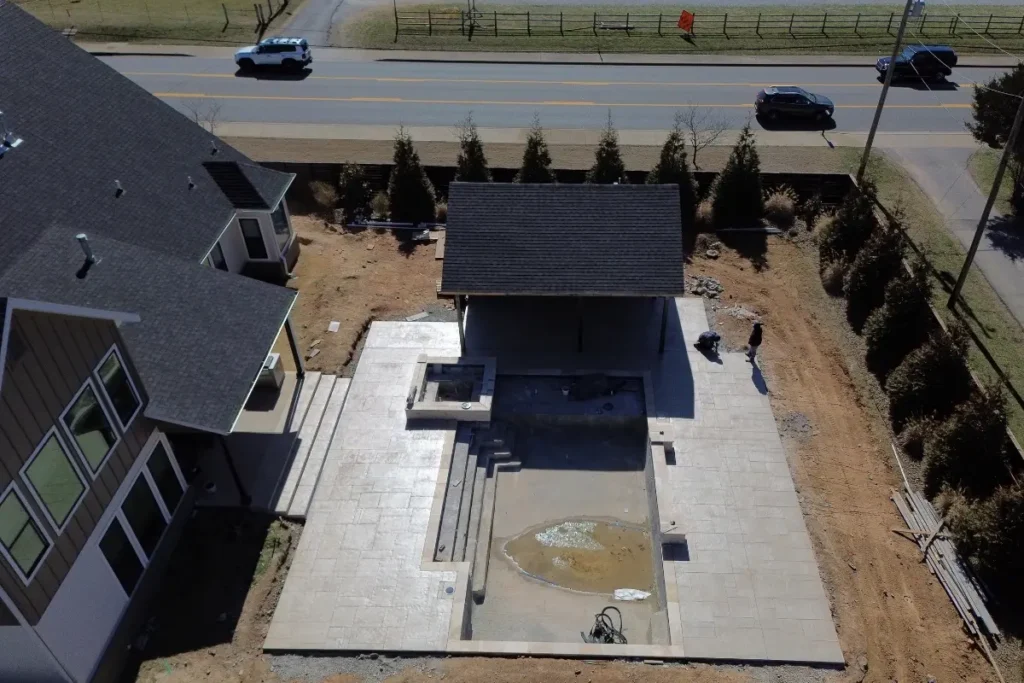
ASA recommends a minimum of 4,000 psi at 28 days for pool shells, even though many pool builders consider 2,500 psi enough. The higher number helps the concrete wrap the steel properly and keeps water from soaking into the shell over the years. It’s a fair question to ask any builder what strength they design for.
Water is where strength usually gets lost. Dry-mix typically runs a lower water-to-cement ratio, about 0.35 to 0.40, compared with about 0.40 to 0.45 for wet-mix. Less water means less shrinkage as the concrete cures. The bigger problem is adding extra water to wet concrete on site so it pumps more easily. ASA says this common practice can push the ratio above 0.50, which weakens the shell and makes it more likely to let water through. A careful crew uses admixtures that help concrete flow without watering it down.
Does One Method Crack Less?
Cracking has many causes, and most have nothing to do with gunite or shotcrete. ASA lists light reinforcing steel, building on poor soil, poor curing, seasonal temperature swings and normal concrete shrinkage. All concrete shrinks as it dries, sprayed or poured.
One cause does come down to the crew: rebound. Rebound is the sand and cement that bounces off the steel during spraying. If it’s left in the floor or in the cove where the wall meets the floor, it becomes a weak spot in the shell. Removing all of it takes discipline, and it matters just as much with wet-mix as with dry-mix.
Ground conditions play a part too. The Arkansas Geological Survey explains that expansive clays in Arkansas shrink and swell as their moisture changes, and that structures built without accounting for it can crack. The most expansive clay it maps runs through central and southern Arkansas, not our corner of the state. Still, sloped yards and clay or rocky soil are common here, and any ground that stays wet and then dries out puts stress on a concrete shell. If your yard holds water after a rain, point it out before the dig starts. If you’re already seeing cracks in an older pool, our guide to common gunite pool cracks explains which ones are cosmetic and which need a closer look.
How a Gunite Shell Should Be Cured
The day the shell is shot is only the start. Concrete keeps gaining strength for weeks, and how it’s cared for in the first days decides a lot about how it holds up. A shell that dries out too fast can lose strength and pick up shrinkage cracks before the plaster ever goes on.
The American Concrete Institute (ACI) defines curing as keeping the right moisture and temperature in fresh concrete so it can keep hardening. ACI says the concrete needs to stay moist inside, above about 80% relative humidity, and above about 50°F for the reactions that build strength to keep going. Controlling moisture and temperature also cuts down on the shrinkage that causes cracks.
Here’s the part that matters most for gunite. ACI notes that for mixes with a water-to-cement ratio below 0.40, simply holding moisture in isn’t enough, and water has to be added during curing, starting as soon as possible. Dry-mix gunite usually falls in that 0.35 to 0.40 range. In plain terms, a gunite shell needs to be watered down after it’s shot, not left to sit in the sun.
Our weather makes this harder in both directions. A hot, windy Northwest Arkansas summer day pulls water out of a fresh shell fast, and ACI notes that keeping free water on the surface also helps carry off heat. In late fall and winter, nights here regularly drop below 50°F, which slows strength gain, so a cold-season shoot needs more planning. Ask your builder exactly how the shell will be cured and for how long. Then ask who is responsible for the watering. A clear answer tells you a lot about the crew.
Which Method Fits a Backyard Pool in Northwest Arkansas?
For most backyard pools, dry-mix gunite is the natural fit. ASA says dry-mix excels in pools under about 1,000 square feet of water surface and in pools with a lot of detail, such as vanishing edges. Pools in that size range can often be shot in a single day.
It also suits tight lots. Many yards here have limited room for trucks and equipment. Dry-mix leaves less mess behind, and the crew can walk on fresh work in the floor without pushing the steel out of place. On a one-day shoot, that matters, because someone has to finish the floor while the walls go up.
That’s why most of the custom pools we build use gunite. Because the crew can pause and restart, it gives precise control over curves and tanning ledges, along with the hard-to-reach spots that make a custom pool look finished.
Wet-mix shotcrete earns its place on bigger jobs. ASA notes it works well for pools over about 1,000 square feet and for builds that take more than one day, and it sprays through crowded rebar with less rebound. A large commercial pool or an oversized residential pool with heavy steel may be a better match for wet-mix. Our builder page puts it the same way: shotcrete works well for larger, less complex pool shells.
For a homeowner, the method usually isn’t a choice you make alone. A good builder picks the method that fits your pool and your yard, then explains the reason in plain words.
Questions to Ask Your Pool Builder
The method matters less than the crew using it. ASA stresses that both processes work well when an experienced, well-trained crew places the concrete correctly. These questions help you tell a careful builder from a rushed one.
| Step | Question to ask | Why it matters |
|---|---|---|
| 1 | Do you use gunite or shotcrete, and why for my pool? | A clear answer shows they matched the method to the job |
| 2 | What concrete strength do you design for? | ASA recommends at least 4,000 psi for pool shells |
| 3 | Is your nozzleman ACI certified? | Placement skill decides how solid the shell is |
| 4 | How do you remove rebound? | Rebound left in the floor or cove becomes a weak spot |
| 5 | Do you ever add water to the concrete on site? | Extra water lowers strength and raises shrinkage |
| 6 | How do you cure the shell after it’s shot? | Poor curing is a common cause of cracking |
Don’t be put off if a builder prefers one method. Most crews specialize, and that’s normal. What you want is a builder who explains the reasons and can show you finished pools that have held up.
Frequently Asked Questions
Is gunite the same as shotcrete?
Mostly, yes. Both are sprayed concrete. In the pool industry, gunite means dry-mix, where water is added at the nozzle, and shotcrete usually means wet-mix, where the concrete arrives already mixed. Technically, ASA treats gunite as one type of shotcrete.
Which is stronger, gunite or shotcrete?
Neither, when the mix is designed right. Strength comes from the concrete mix and how well it’s placed. ASA recommends at least 4,000 psi for pool shells with either method.
Does a gunite pool last longer than a shotcrete pool?
Not because of the method alone. A well-built shell from either method can last for decades. Lifespan depends on the concrete, the steel, the soil and how the pool is cared for over the years.
Why do most backyard pool builders use gunite?
Because it suits smaller, detailed pools. Dry-mix lets the crew stop and start as needed, and it handles detailed shapes well. It also cleans up easily in tight backyards where there’s no room for concrete trucks to wash out.
Can you walk on a gunite pool right after it’s shot?
Yes, with the right mix, ASA says crews can walk on fresh dry-mix and leave little more than a footprint. Wet-mix stays softer, and walking on it too soon can move the steel in the floor.
Does gunite vs shotcrete change the cost of my pool?
Not by much. Price depends far more on the size, design, features and site conditions than on the spraying method. The estimate your builder gives after looking at your yard is the number to trust.
Choosing Between Gunite and Shotcrete for Your Northwest Arkansas Pool
Gunite and shotcrete both build a strong concrete pool. For most backyard pools here, dry-mix gunite is the practical choice, and wet-mix shotcrete makes sense for large pools or builds that run more than a day. The crew matters more than the method, so ask how they control water and remove rebound. Then ask how they cure the shell.
For more detail on both processes, ASA’s article Gunite Versus Shotcrete in Swimming Pool Construction is a good read. If you’re planning a concrete pool and want a pool builder in Northwest Arkansas who will explain the method behind your build, contact BC Pools to set up a free on-site consultation.