
Not every crack in a gunite pool means the shell is failing. Most cracks fall into one of two categories: a shallow cosmetic line in the plaster that’s harmless, or a structural crack in the gunite shell itself that needs professional attention before it gets worse. Knowing which one you’re looking at is the difference between a simple patch and a much bigger repair bill.
We walk clients through this distinction constantly, usually over the phone with someone standing at their pool describing a line they just noticed and trying not to panic. The truth is, gunite is concrete, and concrete cracks. That’s not a defect; it’s the nature of the material reacting to everything around it. What matters is reading the crack correctly.
Why Gunite Pools Crack in the First Place
Gunite is sprayed concrete reinforced with steel rebar, and like any concrete structure, it’s constantly responding to what’s happening in the ground beneath it and the water pressure inside it. A few forces are almost always at work.
Soil movement is the big one here in Northwest Arkansas. The Arkansas Geological Survey notes that expansive clay soils are present across much of the state, and these soils swell when they absorb water and shrink as they dry out, putting repeated pressure on anything built on top of them, concrete foundations included. A pool shell sitting in that kind of soil goes through the same push and pull a house foundation does, just on a smaller, more waterproofed scale.
Freeze-thaw cycles compound that movement. Water in the soil around the shell expands slightly as it freezes each winter, then contracts again as it thaws, and that repeated cycle stresses the concrete over years, not overnight.
Water pressure plays a role too, both from inside the pool and from groundwater pushing against the shell from outside when a pool is drained or when the water table rises. And sometimes, honestly, the cause traces back to the original build. Rebar spaced too far apart or gunite applied too thin in spots can show up as cracks years down the road, and so can a shell that wasn’t cured properly, sometimes long after the original builder is out of the picture.
This is exactly why build quality matters as much as material choice; our gunite and shotcrete pool builder process is engineered specifically around NWA’s expansive clay soil and freeze-thaw cycles to avoid these issues from the start.
Hairline and Craze Cracks
These are the ones that alarm homeowners the most and usually deserve it the least. Craze cracks look like a spiderweb pattern across the plaster surface, thin, shallow, and limited to the finish layer rather than the shell underneath. They typically come from the plaster curing too quickly or from minor shrinkage as the finish sets.
One thing that surprises many pool owners is that these cracks were likely there from very early in the pool’s life. They just weren’t noticeable until the surface aged enough to make them visible. Craze cracks alone rarely signal a structural problem, though a pool with heavy crazing across the entire surface is often a pool whose plaster is nearing the end of its service life anyway.
Structural Cracks in the Shell
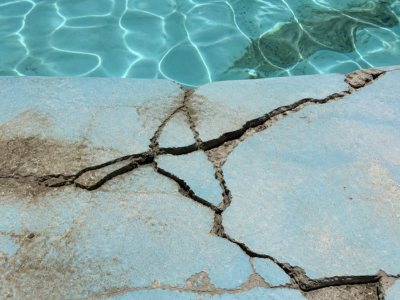
This is a different animal entirely. A structural crack runs through the gunite shell itself, not just the plaster finish, and tends to look more defined than a hairline crack, often longer, with a visible ridge or offset where one side of the crack sits slightly higher or lower than the other.
Location matters a lot here. Cracks that run through the bond beam, along stairs, near the skimmer, or at the transition between a wall and the floor deserve closer attention, since those are naturally higher-stress points in the shell where movement concentrates. If there’s one lesson we’ve learned inspecting cracked pools across NWA, it’s that a crack at one of these transition points is far more likely to be structural than the same size crack running across a flat section of wall.
Cosmetic vs. Structural: A Quick Comparison
| What You’re Seeing | Likely Cosmetic | Likely Structural |
|---|---|---|
| Pattern | Spiderweb or short random lines | Longer, single crack with a defined path |
| Surface feel | Flush, no offset | Visible ridge or offset on either side |
| Location | Flat wall or floor sections | Bond beam, steps, skimmer area, wall-to-floor transitions |
| Water behavior | No unusual water loss | Water level dropping faster than evaporation accounts for |
| Progression | Stable over time | Widening, reappearing after patching |
If a crack checks two or more boxes in the right-hand column, it’s worth having a professional take a look before doing anything else.
What Happens If a Structural Crack Goes Unaddressed
A structural crack doesn’t stay the same size. Every freeze-thaw cycle and every bit of soil movement around it works the crack a little wider, and once water starts finding its way through, it can undermine the soil beneath the shell, which leads to further settling and further cracking in a cycle that gets harder to stop the longer it runs.
We see this most often with pools that had a small, manageable crack for a year or two before an owner finally called. What would have been a straightforward repair earlier on had turned into a section of shell that needed real structural work, simply because the crack had time to keep moving.
What Repair Actually Costs
Costs vary widely depending on crack size, depth, and whether the pool needs to be drained to access it, but there’s a general pattern worth knowing. Small, stable hairline or craze cracks are typically the least expensive to address, often handled with a patch compound or epoxy injection without needing to drain the pool at all. Structural cracks cost considerably more, since they usually require draining, cutting into the shell, and reinforcing the area properly rather than just filling a surface line.
If a structural crack has been left long enough to cause broader shell damage, the repair scope can grow into full resurfacing territory, which is a different conversation entirely from a simple crack repair. This is exactly why getting an early assessment matters. The gap between a minor patch and a several-thousand-dollar structural repair usually comes down to how long the crack sat before someone looked at it.
The only way to get an accurate number for your specific pool is a hands-on inspection, since crack repair pricing depends heavily on access, depth, and location within the shell.
How We Evaluate a Crack
A proper crack evaluation starts with figuring out whether we’re looking at a finish-layer issue or a shell issue, since treating a structural crack like a cosmetic one just delays the real problem. That means checking whether the crack is limited to the plaster or runs through to the gunite, and looking closely at its location relative to bond beams and structural transitions. From there, we also check whether the pool has shown any signs of unusual water loss, since that’s often the clearest confirmation of a structural issue.
From there, the recommendation depends on what we find. A stable, cosmetic crack might just need monitoring or a simple patch. A structural crack usually calls for gunite pool repair that addresses the shell itself, not just the surface. And if the crack is one symptom among several signs of broader surface wear, it’s sometimes part of a larger conversation about whether the pool needs a full gunite pool resurfacing, which is worth reading if you’re already noticing rough texture or staining alongside the cracking.
Frequently Asked Questions
Are hairline cracks in a gunite pool normal?
Yes, to some degree. Minor plaster shrinkage cracks are common and usually cosmetic, though a pool with heavy crazing across the whole surface may be signaling the finish is nearing the end of its life.
How do I know if a crack is structural?
Structural cracks tend to be longer, have a visible ridge or offset, and often run through high-stress points like the bond beam, steps, or skimmer area. If you’re unsure, a professional inspection is the safest route.
Can I repair a gunite pool crack myself?
Small, stable cosmetic cracks can sometimes be sealed with the right patch material. Structural cracks should be evaluated and repaired by a professional, since improper repair can mask a bigger problem.
Do I need to drain my pool to repair a crack?
It depends on the crack. Some minor cracks can be sealed underwater, while structural repairs typically require draining to properly access and reinforce the shell.
Why do gunite pools crack more in Northwest Arkansas than other regions?
Expansive clay soils in this region swell and shrink with moisture changes, and freeze-thaw cycles add additional stress, both of which put more pressure on a pool shell than a region with more stable soil and a milder climate.
Will homeowners insurance cover gunite pool crack repair?
This varies significantly by policy and cause. Check directly with your insurer, since coverage often depends on whether the damage is tied to a specific event or gradual wear.
Can a cracked pool still be used safely?
A small, monitored cosmetic crack usually doesn’t affect safety. A structural crack, especially one associated with water loss, should be evaluated before continued use.
How often should I check my pool for new cracks?
Twice a year is a reasonable baseline, once at the start of swim season and once before winterizing, so any new cracking gets caught early rather than discovered mid-summer.
Does a crack mean my pool needs full resurfacing?
Not necessarily. An isolated crack can often be repaired on its own. Resurfacing usually comes into play when cracking is one of several signs of broader surface wear.
What’s the biggest mistake homeowners make with pool cracks?
Assuming every crack is either nothing to worry about or a disaster. Both extremes lead to the wrong decision, either ignoring something that needed attention or spending more than necessary on a cosmetic issue.
Understanding Gunite Pool Cracks Before They Become a Bigger Repair
Gunite pools crack. It’s a normal part of owning a concrete structure that sits in expansive soil and goes through freeze-thaw winters every year. What separates a manageable repair from an expensive one is catching the crack early and knowing whether it’s cosmetic or structural before deciding how to move forward.
If you’ve noticed a crack in your pool and aren’t sure which category it falls into, contact BC Pools and we’ll take a look and give you a straight answer on what you’re dealing with.