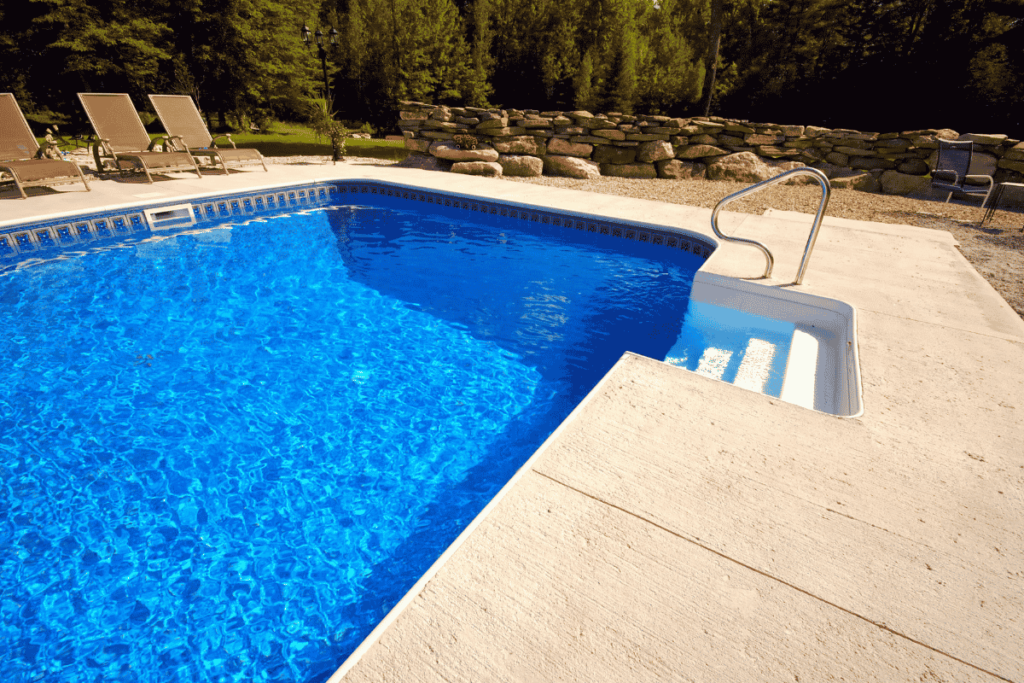
Of the main pool deck options, plain broom-finished concrete costs the least to put in, and travertine stays the coolest under bare feet but costs the most. Concrete pavers sit in the middle on price and are the easiest to fix after a hard winter, because you can lift and replace one piece instead of cutting out a slab.
The right choice comes down to your budget and how you use the deck. How hot it sits in the afternoon sun matters too, and so does how well the ground around your pool drains. Northwest Arkansas adds one more test that buyers in warmer states don’t face: months of nights below freezing followed by sunny afternoons. This guide compares the materials side by side, with prices from independent cost guides and the weather facts that matter here.
Pool Deck Options at a Glance
Here is the short version. The prices are installed costs per square foot from HomeGuide’s pool deck and paver cost guides (December 2025 and April 2026). Your price depends on the deck size and design as well as the ground prep, so treat these as a starting range, not a quote.
| Material | Installed cost per sq ft (HomeGuide) | Feel underfoot in summer | Winter behavior | Repairs |
|---|---|---|---|---|
| Poured concrete, broom finish | $5 to $15 | Gets hot in direct sun | Can crack if the ground moves or water gets in | Patch or resurface; cracks stay visible |
| Stamped concrete | $8 to $19 | Gets hot in direct sun | Same as poured concrete; needs resealing | Color matching on patches is hard |
| Concrete pavers | $10 to $17 | Warm, depends on color | Joints flex, so pieces shift instead of cracking | Lift and reset single pavers |
| Travertine pavers | $13 to $30 for pool decks | 20% to 30% cooler than concrete in direct sun | Needs an outdoor-rated, dense grade and sealing | Replace single stones; keep spares |
Two notes on the table. HomeGuide’s travertine figure is for pool decks specifically, and its example shows a large pool deck costing less per square foot than a small patio from the same installer. The concrete and paver figures are HomeGuide’s pool patio ranges, meaning a deck built on the ground around an inground pool.
What Northwest Arkansas Winters Do to a Pool Deck
A pool deck here has to survive a long freeze season. The National Weather Service’s records for Fayetteville’s Drake Field put the average last freeze in spring on April 16 and the average first freeze in fall on October 19, based on data from 1949 to 2026. You can check the Fayetteville frost and freeze records yourself. That is about six months when a cold night can freeze water sitting in or under your deck.
The bigger issue is the swing from night to day. The Weather Service’s 1991 to 2020 normals for Fayetteville give January a normal low of 25.1°F and a normal high of 47.7°F. So on a typical winter day, water can freeze in the deck overnight and thaw again by afternoon. That cycle repeats many times each winter.
Why that matters: the American Concrete Institute explains that water expands about 9% when it freezes. Water that soaks into a hard surface, or sits in the soil under it, pushes outward every time it freezes. Over many cycles, that pressure widens small cracks and can lift sections of a deck. If you’ve already seen a deck rise or tilt, our post on what causes pool deck heaving explains the soil and drainage side of the problem.
The takeaway for buyers is simple. In our climate, how the deck is built matters as much as the material you pick. Good drainage and a solid compacted base will do more for a deck’s lifespan than any upgrade to the top layer.
Poured Concrete: The Lowest Cost to Start
Poured concrete is a common deck around inground pools and the cheapest way to cover a large area. HomeGuide puts a poured concrete pool patio at $5 to $15 per square foot installed, and a broom-finished concrete patio at $6 to $13. A broom finish is the light texture made by dragging a stiff broom across wet concrete. It costs very little extra and gives bare feet better grip than smooth concrete.
Concrete has real strengths. It is one continuous surface with no joints for weeds to grow in, and HomeGuide says a well-installed concrete patio lasts 30 to 50 years with regular care. It can also be resurfaced later. HomeGuide lists resurfacing a concrete pool deck at $3 to $12 per square foot, which is a lot less than tearing out and starting over.
The weak spots are heat and cracking. Plain gray concrete gets hot in full summer sun. And because it is one solid slab, it can crack when the ground under it shifts or when water gets in and freezes. HomeGuide’s pavers vs concrete guide notes that concrete is more likely than pavers to crack over time from temperature swings or ground movement.
In a freezing climate, ask your installer two questions before the pour. First, is the mix air-entrained? Air-entrained concrete has tiny, evenly spaced air bubbles mixed in on purpose. The American Concrete Institute says those bubbles give freezing water room to expand, and that air-entrained concrete resists freeze and thaw cycles several hundred percent better than concrete without it. Second, where will the control joints go? These are the straight grooves cut into a slab so that, when concrete does crack, it cracks along a planned line instead of across the middle of your deck.
Stamped Concrete: The Look of Stone for Less
Stamped concrete is poured concrete pressed with patterned mats while it is still wet, then colored to look like stone or brick. HomeGuide puts a stamped concrete pool patio at $8 to $19 per square foot installed. Its separate concrete patio guide (July 2025) gives a wider range of $9 to $30, with the top end for complex patterns with several colors and borders.
The appeal is clear: you get a stone or paver look for less than real stone. The trade-off is that stamped concrete is still a slab. It cracks the same way plain concrete does, and a crack is harder to hide because it runs through the pattern. Patches are hard to color-match once the original color has weathered.
Stamped concrete also needs a sealer to protect the color, and that sealer has to be reapplied every few years. Ask your installer how often they recommend resealing. Also ask what they add to the sealer for grip, because some sealers can feel slick when wet, which is the last thing you want next to a pool.
If you already have a plain concrete deck that is sound but worn, you don’t have to replace it to change the look. Coatings and overlays go on over existing concrete, which is one reason resurfacing is often the first thing to price before a full tear-out.
Concrete Pavers: Easier Fixes After a Hard Winter
Concrete pavers are individual blocks made from cement and aggregate, laid on a compacted gravel and sand base with sand swept into the joints. HomeGuide puts a paver pool patio at $10 to $17 per square foot installed. Its pavers vs concrete guide (May 2025) gives a broader $10 to $30 range for pavers, depending on the type and quality of the pavers you choose.
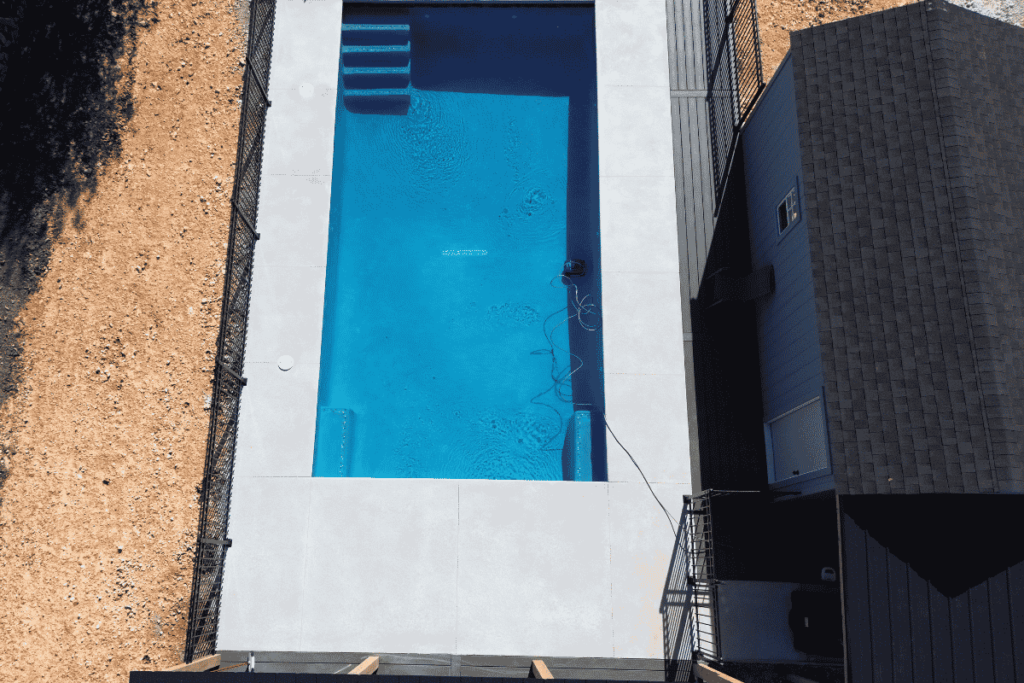
Pavers fit our winters well for one reason: the joints. A slab has nowhere to go when the ground moves, so it cracks. Pavers can shift slightly as a group. HomeGuide says pavers hold up better in harsh weather and typically don’t crack from freeze and thaw cycles. When one does crack or settle, a crew can lift that section and fix the base, then reset the same pavers. HomeGuide says being able to replace pavers one at a time makes repairs cheaper and easier than on concrete.
The downsides are upkeep and base work. Weeds and moss can grow in the joints, and the joint sand may need topping up. Installers typically fill the joints with polymeric sand, which is joint sand with a binder that hardens when wet and holds better than plain sand. A paver deck is also only as good as the base under it. If the base isn’t compacted well or water can’t drain away, pavers will sink and roll at the edges.
Travertine: The Coolest Surface Underfoot
Travertine is a natural limestone that forms around mineral springs. It is popular around pools for one main reason. HomeGuide says travertine stays 20% to 30% cooler than concrete in direct sunlight, which you’ll notice on a July afternoon in Northwest Arkansas.
It is also the priciest of the three. HomeGuide puts travertine pool deck installation at $13 to $30 per square foot. It adds that most pool deck jobs need drainage grading, which adds $500 to $1,500, and sealing, which runs $1 to $3 per square foot and should be redone every two to three years.
The finish matters for safety. HomeGuide says tumbled and brushed travertine gives good grip even when wet, while polished travertine is very slippery when wet and should not be used outdoors. If you see a glossy travertine sample in a showroom, ask for the tumbled version of the same stone for your deck.
Travertine can handle our winters, with conditions. HomeGuide says quality travertine rated for outdoor use can handle freeze and thaw cycles when it is installed with good drainage. Sealing reduces how much water the stone soaks up, which lowers the risk of cracking in freezing weather. For the best freeze and thaw performance in harsh northern climates, it recommends denser, premium grades. Soft, low-grade stone left unsealed is the version most at risk. When you get a quote, ask for the grade and thickness in writing, and ask the supplier to confirm the stone is rated for outdoor use where it freezes.
One practical tip: buy a few extra pavers from the same batch and store them. Natural stone varies from lot to lot, so a matching replacement is easiest to find on the day your deck goes in.
Is It Cheaper to Put Concrete or Pavers Around a Pool?
Up front, concrete is cheaper. HomeGuide’s pavers vs concrete guide gives an average of $6 to $15 per square foot for poured concrete against $10 to $30 for pavers. It puts installation alone at $3 to $5 per square foot for concrete and $7 to $13 for pavers, because pavers are laid one piece at a time.
Over the long run, the gap can narrow. The same guide says concrete’s higher repair and upkeep costs may make it more expensive over time, since a cracked slab needs patching or resurfacing while a damaged paver can be swapped out. If you plan to stay in the home for many years and your yard has drainage or soil movement issues, that long-term cost is worth weighing. If the budget is tight now and the ground is stable, a well-built concrete deck is a sound choice.
How to Choose Your Pool Deck: A Checklist
Walk through these questions before you ask for quotes. Your answers will narrow your pool deck options quickly.
| Step | Question to answer | Why it matters |
|---|---|---|
| 1 | What is your total budget for the deck? | At $5 to $30 per square foot, a 600 sq ft deck can range from about $3,000 to $18,000 before extras |
| 2 | How much afternoon sun does the deck get? | Full sun favors travertine or a light-colored surface for bare feet |
| 3 | Does water pool in your yard after heavy rain? | Poor drainage hurts every material in a freezing winter; fix grading first |
| 4 | Do you have kids or older swimmers? | Grip when wet matters more than looks; avoid polished or slick finishes |
| 5 | How much upkeep will you do? | Pavers need joint care; stamped concrete and travertine need resealing |
| 6 | Is the pool new or existing? | A new pool lets the deck and drainage be planned together from the start |
The deck size in step 1 is only an example to show the spread. Measure your own planned deck and multiply by the ranges in the table above for a rough budget.
If you are still planning the pool itself, talk through the deck with your pool builder in Northwest Arkansas before the shell goes in. The deck slope and drains are easier to get right on paper than to fix later, and so is the edge where the deck meets the pool coping.
Already Have a Deck? Fix It or Start Over
Not every tired deck needs a new material. If the slab is mostly level and the cracks are small, resurfacing or a coating can give it a new look for far less than replacement. HomeGuide’s $3 to $12 per square foot range for resurfacing concrete pool decks compares well with the cost of a new deck.
Replacement makes more sense when sections have heaved or sunk, when water runs toward the pool instead of away from it, or when cracks keep coming back after repairs. HomeGuide notes that replacing an existing deck adds about $5 per square foot for removing and hauling off the old one.
A good first step is an inspection that looks at the base and drainage, not only the surface. Our page on pool deck repair and resurfacing explains the signs to look for and how a repair differs from a full replacement.
Frequently Asked Questions
Which is better for a pool deck, travertine or concrete?
Travertine is better if you want the coolest surface and a natural stone look, and can pay more. Concrete is better if you want the lowest upfront cost. HomeGuide puts a travertine pool deck at $13 to $30 per square foot installed, against $5 to $15 for poured concrete.
What is the least expensive pool deck material?
Plain poured concrete with a broom finish is the least expensive common deck for an inground pool. HomeGuide lists a poured concrete pool patio at $5 to $15 per square foot installed. A broom finish adds very little cost and improves grip when wet.
Is it cheaper to put concrete or pavers around a pool?
Concrete is cheaper to install. HomeGuide gives $6 to $15 per square foot for poured concrete and $10 to $30 for pavers. Pavers can cost less to repair over time because single pieces can be lifted and replaced instead of patching a cracked slab.
Does travertine hold up in freezing weather?
Yes, if it is the right grade and installed well. HomeGuide says outdoor-rated travertine can handle freeze and thaw cycles with good drainage and sealing. Choose a dense, premium grade with a tumbled finish, and reseal it every two to three years.
How much does a pool deck cost per square foot?
For the four materials in this guide, a ground-level deck around an inground pool costs about $5 to $30 per square foot installed. HomeGuide’s ranges run from $5 to $15 for poured concrete up to $13 to $30 for travertine, and its pool patio table goes up to $35 for other natural stone. Drainage work and removing an old deck cost extra.
Which pool deck material stays coolest in summer?
Travertine stays the coolest of the common deck materials. HomeGuide says it stays 20% to 30% cooler than concrete in direct sunlight. Lighter colors also stay cooler than dark ones, so color is worth considering with any material.
Choosing Between Pool Deck Options in Northwest Arkansas
There is no single best deck for every backyard. Poured concrete gives you the most deck for the money. Pavers cost more but handle our freeze and thaw winters with easier repairs. Travertine costs the most and stays the coolest, as long as you choose an outdoor-rated grade with a tumbled finish and keep it sealed.
Whatever you pick, put the base and drainage first. In a region with about six months of freezing nights, water under the deck does more damage than any choice of surface. If you’d like help weighing the options for your yard or checking the deck you have now, contact BC Pools.