
Fiberglass pool maintenance runs on tighter chemistry margins than most owners expect, even though the gel coat needs less brushing and fewer chemicals overall. The surface is smooth and semi-permeable rather than porous, which is exactly why calcium and pH have to be managed differently here than they would on plaster.
We get this backwards from new fiberglass owners more than almost anything else. They hear “low maintenance” and assume that means “flexible on chemistry.” It’s closer to the opposite. Fiberglass tolerates less chemical drift before the surface itself starts to show it.
Why Fiberglass Chemistry Works Differently
A plaster surface is porous and actually needs some calcium in the water to stay stable, otherwise the water pulls calcium out of the plaster itself. Gel coat doesn’t have that relationship with the water at all. It’s a semi-permeable resin surface, not a mineral one, so calcium that plaster wants is exactly what causes scaling and dulling on a fiberglass finish.
That difference is the reason fiberglass chemistry targets look narrower than what a plaster pool owner is used to. It’s not that fiberglass is more finicky in general. It’s that the surface reacts to a different set of imbalances than a concrete shell does.
The Chemical Balance Fiberglass Actually Needs
The CDC recommends a general residential pool pH range of 7.0 to 7.8 for effective disinfection and swimmer comfort, regardless of surface type. Fiberglass manufacturers and pool professionals typically recommend narrowing that further, to 7.2 to 7.4, since gel coat is more sensitive to pH drift than a plaster surface is.
Free chlorine generally sits at 1 to 3 ppm, and calcium hardness is kept low, usually under 120 ppm. Cyanuric acid is held around 30 to 50 ppm, enough to protect chlorine from UV breakdown without over-stabilizing it.
Chlorine source matters more here than most owners realize. Calcium hypochlorite adds calcium to the water with every dose, and on a fiberglass pool that calcium has nowhere useful to go, it just accumulates toward the scaling threshold over a season of regular shocking. Liquid chlorine (sodium hypochlorite) adds no calcium and is the more common recommendation for routine sanitizing and shocking a fiberglass shell.
Fiberglass Chemistry Targets at a Glance
| Parameter | Fiberglass target | Why it matters here |
|---|---|---|
| pH | 7.2 to 7.4 | Tighter than plaster’s typical 7.4 to 7.6 range |
| Free chlorine | 1 to 3 ppm | Standard sanitizing range |
| Calcium hardness | Under 120 ppm | Excess calcium scales and dulls the gel coat |
| Cyanuric acid | 30 to 50 ppm | Protects chlorine without over-stabilizing |
| Chlorine source | Liquid chlorine preferred | Avoids the calcium load that cal-hypo adds |
Treat these as a starting framework, not a substitute for your pool’s specific manufacturer guidance, since some gel coat formulations carry their own recommended ranges.
Why a Drifting pH Is a Bigger Deal on Fiberglass
Here’s the part that ties directly back to surface damage rather than just water clarity. As pH climbs above roughly 7.8, gel coat becomes more vulnerable to osmotic blistering, the same blistering we covered in detail in our post on signs your fiberglass pool needs repair. At sustained high pH, that risk accelerates rather than climbing gradually.
This is a genuinely useful thing to understand as an owner, not just a technician’s detail. A blister that shows up months later often traces back to a stretch of neglected pH, not a manufacturing flaw in the shell itself. Keeping pH in range isn’t just a water-clarity habit on a fiberglass pool, it’s part of protecting the surface itself.
The Weekly Cleaning Routine
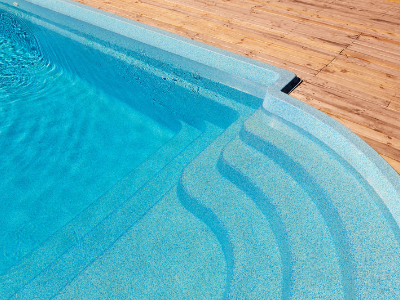
Skim debris and empty the skimmer basket regularly, since fiberglass doesn’t stop needing basic upkeep just because the surface resists algae. Brush the walls and floor with a soft nylon brush, never a steel brush or an abrasive pad, since those can scratch and dull the gel coat in ways that don’t buff back out.
Vacuum periodically to clear whatever settles on the bottom, and if you’re running a robotic cleaner, most are chemically compatible with a properly balanced fiberglass pool. The routine itself is genuinely lighter than a plaster pool’s, the difference is how closely the chemistry needs to stay in range while you do it.
Common Mistakes That Damage Gel Coat
More often than not, gel coat problems trace back to a short list of avoidable habits rather than the surface simply wearing out. Using cal-hypo shock repeatedly is one, since the calcium buildup happens quietly over a season before it shows up as visible scaling. Letting pH drift high and stay there is another, especially over an extended stretch without testing.
Aggressive cleaning tools are a third. A steel brush or a harsh abrasive pad might seem like a faster way to clear stubborn buildup, but it leaves fine scratches in the gel coat that actually make future staining and algae adhesion easier, not harder.
Stain and Scale Prevention
A sequestering or stain-and-scale product, added on a regular schedule rather than only when discoloration appears, is one of the more overlooked parts of a fiberglass routine. It binds trace metals and minerals in the water before they have a chance to settle onto the gel coat, which matters more here than on plaster, since fiberglass staining tends to show up as a dulled patch that’s harder to fully reverse once it sets in.
This is a small, recurring cost that’s easy to skip when the water looks fine. The problem is that gel coat staining is often more visible dry than wet, so a pool that looks perfectly clear can still be building up the kind of buildup that shows up clearly once the water level drops for the season.
Filter and Equipment Care
Filtration matters just as much on a fiberglass pool as any other, even though the surface itself asks less of the water. A clogged or poorly maintained filter lets fine debris recirculate, and that debris is what a stain-and-scale product and regular brushing are working against in the first place.
Keep the skimmer and pump baskets clear on a consistent schedule, and follow your filter manufacturer’s cleaning interval rather than waiting for a visible drop in water clarity to prompt it. Circulation problems tend to show up as chemistry problems first, cloudy water or chlorine that seems to disappear faster than usual, before anyone thinks to check the filter itself.
A Quick Note on Seasonal Transitions
Opening and closing a fiberglass pool each year puts its own stress on water chemistry, since the water sits without regular testing for months at a time. The short version for chemistry purposes is this: balance the water fully before closing, rather than closing a pool that’s already drifted out of range, since a season spent out of balance is a season the gel coat spends absorbing that imbalance.
How This Fits Alongside Gunite Maintenance
If you’re comparing notes with a gunite pool owner, the routines will sound different, and they are. A gunite pool leans on more frequent brushing and higher chemical volume because the plaster surface is porous. Fiberglass leans on tighter chemistry precision instead. Neither one is more demanding overall, they’re just demanding in different places.
Frequently Asked Questions
What pH range is best for a fiberglass pool?
Generally 7.2 to 7.4, which is tighter than the range commonly used for plaster pools, since fiberglass gel coat is more sensitive to pH drift than a porous concrete surface.
Can I use the same chemicals I’d use in a gunite pool?
Not exactly. Calcium hypochlorite, common in concrete pool maintenance, adds calcium that builds toward scaling thresholds on fiberglass. Liquid chlorine is generally the better fit for routine sanitizing.
Why is calcium hardness a problem for fiberglass specifically?
Gel coat doesn’t need calcium the way plaster does, so excess calcium has nowhere useful to go and instead contributes to scaling and dulling on the surface.
Can high pH really cause blistering?
Sustained high pH is one of the contributing factors behind gel coat blistering. It’s a water chemistry issue rather than a manufacturing defect, which is part of why consistent testing matters.
What kind of brush should I use on a fiberglass pool?
A soft nylon brush. Steel brushes and abrasive pads can scratch the gel coat, and those scratches make future staining and algae adhesion easier.
How often should I test the water on a fiberglass pool?
At minimum weekly. The CDC recommends routinely testing chlorine and pH on any residential pool, and testing more often during heavy use, regardless of surface type.
Do I still need to shock a fiberglass pool?
Yes. Fiberglass needs less frequent shocking than a porous surface, but it isn’t chemical-free. A non-chlorine or liquid chlorine shock is generally preferred over cal-hypo.
Is a robotic pool cleaner safe for fiberglass?
Generally, yes, most robotic cleaners are compatible with a properly balanced fiberglass pool. Confirm compatibility with your specific cleaner’s manufacturer if you’re unsure.
Does fiberglass really need less maintenance than gunite overall?
Yes, in terms of brushing frequency and total chemical volume. The tradeoff is that the chemistry that is required needs to stay within a narrower range to protect the gel coat.
What’s the biggest maintenance mistake fiberglass owners make?
Assuming low maintenance means low attention. Skipping regular testing or letting pH drift for weeks is what typically leads to scaling or blistering down the road.
Keeping a Fiberglass Pool’s Chemistry and Surface in Good Shape
Fiberglass pool maintenance trades frequent brushing and heavy chemical volume for a narrower, more precise chemistry window, and understanding that tradeoff is what keeps the gel coat looking and performing the way it’s supposed to. Calcium and pH both matter more here than they would on a plaster surface, and so does the chlorine source you use. The routine itself is lighter once you know what to watch.
If chemistry has already drifted far enough to cause visible scaling or blistering, that’s a fiberglass pool repair conversation rather than a chemistry fix alone. Otherwise, if you’re not sure whether your fiberglass pool’s chemistry is where it needs to be, contact BC Pools and we’ll take a look and help you build a routine that actually protects the surface.