
The fiberglass pool installation timeline in Northwest Arkansas runs about 4 to 6 weeks from the first shovel of dirt to your first swim. From the day you sign a contract, plan on roughly 8 to 12 weeks once the paperwork and the shell order are added.
Only a slice of those weeks is a crew actively building something. The rest is waiting, whether on concrete to cure or on an inspector’s calendar, and that’s why the number you hear depends on who’s counting and where they start.
Here is what happens each week, and what tends to stretch it.
Why You’ll Hear Different Timelines for the Same Pool
Ask around and you’ll hear three different answers. None of them is wrong. Each one measures a different stretch of the project.
| The number you’ll hear | What it actually measures |
|---|---|
| About a week | Excavation and setting the shell, the part most people picture |
| 4 to 6 weeks | Excavation to first swim, with waits for cure time and inspections built in |
| 8 to 12 weeks | Signed contract to first swim, with the paperwork and the shell order added |
Most confusion comes from comparing one company’s first number to another company’s third. Ask any builder which stretch of the project their number covers before you compare it to anyone else’s.
The Fiberglass Pool Installation Timeline at a Glance
Here is the schedule in one place. Every project shifts with the site and the season.
| When | Main work | Most common holdup |
|---|---|---|
| Before week one | Design and approvals, plus the shell order | Permit review and shell lead time |
| Week one | Excavation and shell set | Rock and wet ground |
| Week two | Backfill and water fill, with plumbing | Pre-backfill and plumbing inspections |
| Week three | Equipment hookup and rough inspections | Electrical inspection scheduling |
| Weeks four and five | Concrete deck and coping | Concrete cure time and rain |
| Weeks five and six | Final inspection and startup | Final inspection scheduling |
Inspections sit between these steps. Many cities require a pre-backfill inspection after the shell is set, along with rough electrical and plumbing checks before those lines are covered. A final inspection comes last, and the pool can’t be used until it’s signed off.
The shell itself is the quick part. Most of a 4 to 6 week schedule is waiting, on concrete to cure and on inspectors and trades to line up.
Before Week One: Paperwork and the Shell Order
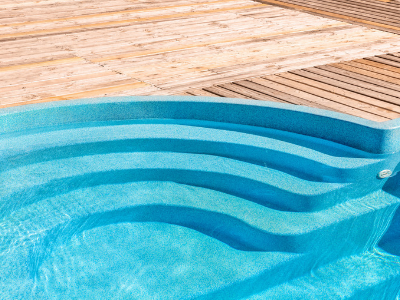
The 4 to 6 week clock doesn’t start until the excavator arrives, and a lot has to happen before that. You choose a shell and the site gets evaluated. Utilities get marked, and the permit application goes in. If your neighborhood has an HOA, its review may have to finish before the city will accept an application.
Two pieces of this stage surprise people. The first is shell lead time. A popular shape is often in stock, but a less common one ordered in a busy season can wait several weeks on a manufacturer’s production schedule, so ask about lead time on the shell itself before you lock in a start date.
The second is the permit. Smaller offices can turn a review around in days, but busier offices such as Fayetteville’s and Bentonville’s can take several weeks during the busy spring season, when everyone applies at once. Drainage questions or easements can stretch a review further. Permits can also expire. In Rogers, for example, a residential pool permit is only valid for six months and can be voided if work stalls, so the permit and the start date need to be timed together. That’s why the full contract-to-swim timeline lands at 8 to 12 weeks. We walk through how permitting and HOA review stretch every pool type in our post on how long it takes to build a pool in NWA.
Week One: Excavation and Setting the Shell
Week one is the part everyone pictures. Utilities are marked and the layout is sprayed out, then an excavator digs the hole with room for a level stone base underneath. When the base is ready, a crane lifts the shell into place and the crew checks that it sits level. A careful crew takes as long as it needs to get that right, because everything built afterward depends on it.
We plan on about a week for excavation and setting the shell, because weather and crane scheduling both get a vote. Then there’s whatever the ground is hiding. Rock close to the surface needs specialized equipment to break up, and that is a very different pace from digging soil. Most Northwest Arkansas lots carry some mix of rock and clay, and you rarely know how much until the bucket is in the ground.
Many cities also want an inspector to see the work before anything is covered. Because a fiberglass shell arrives pre-engineered, there’s typically less for the inspector to evaluate than on a poured shell, but the crew generally waits for that sign-off before backfilling.
One thing that surprises many homeowners is how unfinished the pool still looks the day the shell goes in. It’s sitting in an open hole, and nothing gets covered until it has been checked and locked in.
Week Two: Backfill and Water Fill
Once the shell is set and level, the crew has to lock it in without letting it flex. The method is to backfill around the shell while filling it with water, so the pressure inside and outside stays balanced. That water is part of holding the shell steady, not a fill for swimming. The pool still can’t be used until the final inspection is signed off.
That’s why nobody should hurry this stage. If the backfill gets ahead of the water, or the water gets ahead of the backfill, a wall can bow. Plumbing lines are connected and pressure-tested as the work rises past each fitting. Depending on your city, an inspector may need to see the plumbing lines before the backfill covers them, which can mean a pause mid-stage. Features like a tanning ledge add steps of their own, which is another way a short stage stretches.
Week Three: Equipment Hookup and Rough Inspections
With the shell locked in, the crew sets up the equipment pad and connects the pump and filter, plus a heater or automation if you’ve chosen one. Because the plumbing and electrical lines were run in earlier steps, hookup itself moves quickly.
Inspections are where calendars diverge. Rough electrical checks have to happen before those lines are closed up. Whether an inspector arrives the next morning or the following week depends on your city or county, not on your builder. That waiting is a frequent source of the gaps between steps. If a heater or an automation system ties into your electrical panel, that work adds time too. A builder who works in your city regularly usually knows how far ahead to book.
Weeks Four and Five: Concrete Deck and Coping
This is where the calendar and the crew’s working days part ways. Forming and pouring the deck is quick work, but the concrete then needs real time to cure before anyone walks on it. Coping (the trim around the pool’s edge) and the decking follow. While the concrete cures, the schedule slows down on purpose, and rushing it isn’t an option.
Weather has more say here than in any other stage. A wet week can push a pour, and a pour that slips pushes everything behind it. Late decisions cost time too, so settle your decking and coping choices before the excavator shows up rather than while the forms are going in.
A barrier belongs to this stage as well. The Arkansas Department of Health states that it does not regulate single-family residential pools and that fencing requirements for them vary under local ordinances. In other words, the rules come from your city or county, so confirm what your fence has to look like and when it has to be in place before you order it.
Weeks Five and Six: Final Inspection and First Swim
The last stretch is short but easy to underestimate. The final inspection generally follows the deck and barrier work, and the pool can’t be used until it’s signed off. After that comes equipment startup and a walkthrough. The crew tests the system and balances the water, then walks you through how everything operates.
Your first swim lands somewhere between the end of week four and the end of week six, depending on how many of the earlier gaps closed cleanly. If every stage moved on schedule, you’re at the short end. If the concrete slipped a few days and the inspector’s first opening was the following week, you’re at the long end. Neither one means something went wrong.
Why the Shell Goes In Fast and the Schedule Still Takes Weeks
Setting the shell takes about a week, and that part really is fast compared with building a pool in place. The rest of the schedule is the part homeowners don’t picture. Concrete crews and electricians work on more than one job, and inspectors keep their own calendars. A stretch of rain can reset the schedule for a week.
The truth is, the number that matters to you is the calendar one. That’s why we quote 4 to 6 weeks from excavation to first swim and treat anything faster as a bonus rather than a promise.
What Slows a Fiberglass Install in Northwest Arkansas
A few conditions show up often enough in this region that we plan for them before we quote a timeline.
Rock is the biggest. As covered in week one, rock close to the surface needs specialized equipment to break up, and soft or unstable ground may need extra preparation before the shell can go in. Both are common enough here that we treat them as possibilities on every lot rather than surprises.
Access is the second. A fiberglass shell arrives in one piece, so heavy equipment needs a clear route to the backyard. On a wooded or sloped lot with a narrow side yard, that can add real time and cost, and sometimes it changes the pool conversation entirely. Those lots are common in Bella Vista and Fayetteville.
Weather rounds it out. Spring rain can stop excavation for days at a time, and a soaked yard turns a crane route into mud.
How to Keep Your Installation on Schedule
You can’t control the weather, but a few decisions are yours. Ask about shell lead time before you commit to a start date. Find out early whether your HOA needs to approve the design before the city will accept a permit application. Walk the access path with your builder and clear whatever needs clearing before the equipment arrives.
Settle your decking and features before the dig, since late changes hold up a crew that’s waiting on them. And ask which inspections your city requires and who books them, because that single answer explains a lot about the gaps in a timeline. A builder who does fiberglass pool installation regularly will usually raise these questions before you do.
When to Start If You Want to Swim by Summer
Working backward is the honest way to plan. Since the whole project runs about 8 to 12 weeks from contract, starting design and permitting in February or March typically points to a late May or June swim. Permit offices are busiest from February through June, though, so a review in that window can run longer than one submitted in late fall or winter. If Memorial Day is your target, start earlier, when offices are slower and shell lead time has room to work. A heater also keeps the pool comfortable later into the fall, so a slightly later finish doesn’t cost you the whole season.
Frequently Asked Questions
How long does a fiberglass pool installation take in Northwest Arkansas?
Most projects take 4 to 6 weeks from excavation to first swim. Counting the paperwork and the shell order from the day you sign, the full project usually runs 8 to 12 weeks.
How long does it take to set the fiberglass shell?
We plan on about a week for excavation and setting the shell, to allow for weather and crane scheduling.
Why does installation take weeks if the shell arrives in one piece?
The shell is only the beginning. Backfill and plumbing come next, followed by equipment hookup and the concrete deck. The concrete then needs time to cure. Inspections add waiting time between steps.
Can I swim as soon as the shell is set?
No. Most of the work comes after the shell is set, and the pool can’t be used until the final inspection and startup are complete.
Does rain delay a fiberglass pool installation?
Yes. Wet weather can stop excavation and push back concrete pours, and a soaked yard is hard on the equipment that has to reach it.
Does rock on my lot add time?
It can. Rock close to the surface needs specialized equipment to break up, which is slower than digging soil.
How long does the permit take before work begins?
It depends on your city and the season. Smaller offices can turn a review around in days, while busier ones can take several weeks in spring. Drainage questions or easements can add more.
What inspections happen during a fiberglass pool installation?
Many cities in the region require a pre-backfill inspection and rough electrical and plumbing checks. A final inspection comes last, and the pool can’t be used until it’s signed off.
Do features like a tanning ledge or spa change the timeline?
Yes. Each feature adds its own steps, and some add curing or installation time on top of the main schedule.
When should I start if I want to swim by summer?
Starting design and permitting in February or March typically points to a late May or June swim. For an earlier date, start sooner.
Planning Your Fiberglass Pool Installation Timeline in Northwest Arkansas
The fiberglass pool installation timeline comes down to two clocks: 4 to 6 weeks from excavation to first swim, and 8 to 12 weeks from a signed contract. The crew’s actual working days are a fraction of either number, and the rest is waiting on cure time and inspections. Knowing where those gaps fall is what lets you plan around them.
If you’d like a schedule built around your actual lot and your shell choice, contact BC Pools and we’ll walk the site and map it out with you.