If you’ve asked three different pool companies which type to build, you’ve probably gotten three different answers. That’s not because anyone’s lying to you. It’s because the honest answer depends on your lot, not on which material a builder happens to specialize in. Gunite, fiberglass, and vinyl liner pools each solve a different problem, and the right one for a flat, sandy lot in Rogers is often the wrong one for a sloped, rocky lot fifteen minutes away in Fayetteville.
We’ve built and renovated all three pool types across Northwest Arkansas for three generations now, going back to Torres Construction Group’s start in 1966. This guide walks through what actually separates gunite, fiberglass, and vinyl liner pools when you’re building on Ozark terrain specifically, not the generic national comparison you’ll find on most pool company websites, which rarely account for limestone bedrock, clay soil, or the freeze-thaw winters we get here.
How We Walk Homeowners Through This Decision
Most homeowners start this research with a preference already in mind, usually based on price. Here’s the thing: price is real, but it’s the third or fourth factor we actually evaluate, not the first.
The first thing we look at is the lot. Slope, soil composition, tree root systems, and access for equipment determine which pool types are even feasible before cost enters the conversation. The second is how the family plans to use the pool: daily swimming versus occasional entertaining changes the maintenance-versus-customization tradeoff considerably. Only after those two questions are answered does budget start narrowing the field.
That order matters because a homeowner who falls in love with a fiberglass shape online, then finds out their backyard doesn’t have crane access, has wasted weeks. Starting with the lot avoids that.
Gunite Pools: Built for Ozark Terrain
A gunite pool is built, not delivered. Steel rebar is set into an excavated hole, then a sand-cement mixture is sprayed over the frame and shaped on site, which is why it’s the only pool type that can be engineered into virtually any shape, depth, or configuration a property calls for. We cover the full step-by-step process, including how curing and finish work, in our guide to What Is a Gunite Pool? A Northwest Arkansas Guide.
That flexibility is exactly why gunite dominates our project list across Bentonville, Fayetteville, Rogers, and Springdale. A lot of what looks like a routine backyard here is sitting on limestone shelf, has an eight to twelve foot elevation change from one corner to another, or backs up to mature trees with root systems a crane truck simply can’t get past. Gunite doesn’t need to work around those conditions. It gets engineered around them, one rebar cage and one soil report at a time.
The tradeoff is time and surface maintenance. A gunite shell needs a curing period before plaster or pebble finish goes on, which is part of why builds run 12 to 20 weeks rather than a handful of weeks. Once it’s finished, the plaster surface is textured, which gives algae something to grip if chemistry isn’t maintained consistently, and it’s why gunite owners typically spend more weekly time brushing and balancing water than fiberglass owners do. Most of our clients land somewhere around three to four hours a month on routine upkeep once the pool settles in, more if the water chemistry drifts.
Saltwater chlorination systems work fine with gunite, for what it’s worth. That’s a detail that gets left out of a lot of comparison articles, since salt systems are sometimes assumed to be fiberglass-only.
Gunite is the pool type built for irregular, sloped, or rocky Ozark lots, offers full custom design, and typically lasts 30 to 50-plus years structurally, but it costs more upfront and needs resurfacing roughly every 10 to 15 years. We build these as a gunite and shotcrete pool builder across Bentonville, Fayetteville, Rogers, and Springdale, with plenty of recent project examples to look through.
Fiberglass Pools: Speed and Low Maintenance, With Real Tradeoffs
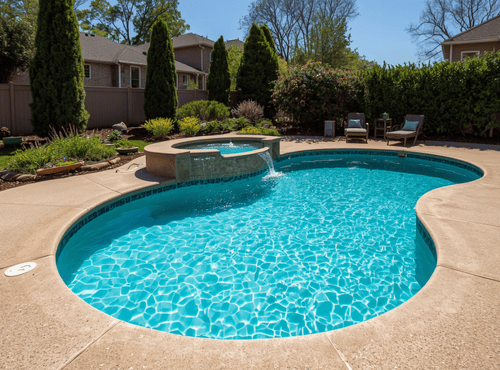
A fiberglass pool arrives as a single manufactured shell and gets craned into an excavated hole in one piece. That’s the entire reason fiberglass builds finish in a fraction of the time gunite does, often four to eight weeks from excavation to first swim.
The gel-coat surface is smooth and non-porous, so it resists algae far better than textured plaster, and most fiberglass owners we talk to spend closer to one hour a week on upkeep rather than several. That maintenance gap is real, and it’s the single biggest reason families choose fiberglass when they’re not particularly interested in pool care as a hobby.
What doesn’t get discussed as often: fiberglass shells can develop something called osmotic blistering, small bubbles under the gel coat caused by water intrusion through microscopic imperfections in the coating. It’s not common with a properly manufactured and installed shell, and it’s rarely structural, but it’s a real consideration over a 20-plus-year ownership window, and homeowners shopping fiberglass should ask any builder directly about the manufacturer’s blister warranty rather than assuming it isn’t an issue.
The bigger limiting factor in our region is access. A fiberglass shell has to travel from the manufacturer to your backyard in one piece, which means the crane needs a clear path. On a flat lot in a newer Bentonville or Centerton subdivision, that’s rarely a problem. On a wooded, sloped lot with a narrow side yard, it can rule fiberglass out entirely, or add enough tree removal and access costs that gunite ends up being the more practical option once site work is priced in.
Fiberglass installs fastest, needs the least routine maintenance, and holds up well structurally, but it requires decent site access and offers less design flexibility than gunite. Shell shapes and sizing details are on our Fiberglass Pool Installation page.
Vinyl Liner Pools: The Budget-Flexible Option
A vinyl liner pool uses a wall structure, typically steel or polymer panels, with a custom-cut vinyl sheet stretched over it and a groomed sand or concrete floor underneath. It’s the lowest upfront cost of the three types, and it offers more shape flexibility than fiberglass since the liner is fabricated to fit whatever frame shape you choose.
The honest tradeoff is the liner itself. Depending on sun exposure, water chemistry, and how carefully the pool is closed for winter, most liners last somewhere between seven and twelve years before they need replacing, a recurring cost that gunite and fiberglass owners simply don’t budget for. We’ve seen liners last close to fifteen years with disciplined water balance and a good winter cover routine, and we’ve seen liners fail in five when chemistry was neglected or a cover wasn’t used. That range is wide because liner life is one of the few pool ownership factors that’s genuinely in the homeowner’s hands.
One thing that surprises many homeowners: vinyl liner walls are also more sensitive to soil movement than gunite, which matters on our clay-heavy Ozark soils where ground can shift noticeably between wet spring seasons and dry summers. It’s not a disqualifying issue, but it’s part of why we evaluate soil composition carefully before recommending vinyl liner on certain lots.
Vinyl liner offers the lowest entry cost and solid shape flexibility, but expect a liner replacement roughly every 7 to 12 years and slightly more sensitivity to soil movement than gunite or fiberglass. More on wall systems and liner options is on our Vinyl Liner Pool Installation page.
Cost Comparison: What NWA Homeowners Actually Pay
| Gunite | Fiberglass | Vinyl Liner | |
|---|---|---|---|
| Typical installed cost, NWA | $85,000-$200,000+ | $50,000-$100,000* | $40,000-$75,000* |
| Install timeline | 12-20 weeks | 4-8 weeks | 6-10 weeks |
| Resurfacing/replacement cycle | Every 10-15 years | Rarely needed | Every 7-12 years |
| Typical routine maintenance | 3-4 hrs/month | ~1 hr/week | 1-2 hrs/week |
| Structural lifespan | 30-50+ years | 25-30+ years | 15-20 years |
*Fiberglass and vinyl liner figures reflect national installed-cost ranges; final NWA pricing depends on shell size, site access, and finish selections. A site visit gives an exact number.
Upfront price only tells part of the story. Over a 20-year ownership window, gunite’s higher entry cost is offset by fewer major replacement events: two to three resurfacing cycles rather than a full shell replacement. Fiberglass tends to post the lowest total cost of ownership of the three, since the gel coat rarely needs work and chemical usage runs lower. Vinyl liner’s savings narrow over time once two or three liner replacements are factored in, though it still typically remains the least expensive option for homeowners planning a shorter ownership horizon. We’ve broken down what actually drives gunite pricing up or down on NWA terrain elsewhere on the blog, if exact numbers are what you’re after.
Durability on Ozark Soil: Why Terrain Changes the Calculus
More often than not, when a fiberglass or vinyl liner pool in this region develops a structural problem, soil movement is the root cause, not a manufacturing defect. Northwest Arkansas sits on a mix of limestone bedrock and clay-heavy topsoil that expands and contracts with moisture, and our winters bring enough freeze-thaw cycling to move ground that looked stable in October.
Gunite handles that movement best because it’s engineered on site, with rebar spacing and footing depth matched to an actual soil report rather than a standardized shell design. Fiberglass shells flex slightly with minor ground shifting, which works in their favor on moderately stable soil, but a shell installed without proper engineered backfill on a site with real slope or drainage issues is where we most often get called in for a fix years later. Vinyl liner walls are the most exposed to this risk, since panel joints and liner seams don’t tolerate uneven settling as gracefully as a monolithic gunite shell or a flexing fiberglass shell.
None of this means fiberglass or vinyl liner is a bad choice here. Thousands are built successfully across the region every year. It means the soil and drainage evaluation before construction matters more in Northwest Arkansas than it does in a region with flat, sandy, stable ground.
Maintenance Reality Check: Hours, Chemicals, and What Breaks First
The truth is, maintenance comparisons in most pool articles are too vague to be useful. Here’s what we actually see across the three types once a pool has been in the ground a few years:
- Gunite: More brushing due to surface texture, higher chemical usage, resurfacing every 10 to 15 years. Watch for chalky or rough patches on the plaster, which usually signal the surface is nearing the end of its cycle rather than an immediate problem.
- Fiberglass: Lowest chemical and labor demand. Watch for gel-coat discoloration or small bubbling, which is worth having inspected early rather than waiting. Catching osmotic blistering before it spreads is far cheaper than addressing it later.
- Vinyl liner: Moderate chemical needs, but liner-specific watch points, like wrinkling, fading, or soft spots underfoot, that don’t apply to the other two types at all.
Believe it or not, the pool type doesn’t matter nearly as much as consistency once you’re a few years in. A well-maintained vinyl liner pool with a disciplined owner will outlast a neglected gunite pool’s plaster finish by years. The material sets the maintenance floor and ceiling; the owner’s habits determine where the pool actually lands.
Energy Efficiency and Heating Costs by Pool Type
This is one of the more overlooked factors in pool-type comparisons. Gunite’s thicker shell holds heat slightly longer overnight than fiberglass or vinyl liner, which can modestly reduce heater run time for owners who heat their pool through spring and fall shoulder seasons. Fiberglass and vinyl liner shells lose heat a bit faster due to thinner wall construction, though the difference is generally small enough that pump and heater efficiency, pool cover use, and surface area matter more to your actual energy bill than shell material does. If heating costs are a priority, a cover and a properly sized variable-speed pump will do more for your bill than the choice between these three pool types.
Warranty Considerations Homeowners Often Overlook
Warranty terms vary more by builder and manufacturer than by pool type, but there are structural differences worth asking about directly. Gunite warranties typically cover the structural shell for a long period, often lifetime-to-the-original-owner on structural integrity, with plaster or pebble finish covered separately and for a much shorter window. Fiberglass warranties usually cover the shell itself against structural failure and blistering for a defined term set by the manufacturer, which is worth confirming since blister coverage isn’t automatic on every shell. Vinyl liner warranties tend to cover the structural wall system longer than the liner, since the liner is treated as a wear item from the start.
If there’s one lesson we’ve learned quoting all three types side by side, it’s that homeowners rarely ask what’s not covered until something goes wrong. Ask specifically what’s excluded. Soil movement, chemical damage, and improper winterization are common exclusions across all three pool types.
Resale Value in Northwest Arkansas Neighborhoods
Gunite pools generally carry the strongest resale impact in NWA, largely because buyers view a custom concrete pool as a permanent, high-end feature rather than an add-on that will need major work soon after purchase. Fiberglass holds value reasonably well, particularly in newer subdivisions where buyers expect lower-maintenance features. Vinyl liner pools tend to have the least resale premium of the three, in part because buyers factor in an unknown liner age and the near-term replacement cost that comes with it.
That said, resale value is neighborhood-dependent. In more budget-conscious markets, an oversized gunite pool can occasionally be viewed as a maintenance burden rather than an asset. A site-specific and market-specific conversation is worth having if resale is a primary driver of your decision.
A Decision Framework: Matching Pool Type to Your Lot and Lifestyle
At first glance, these three options can feel interchangeable. They’re all “inground pools,” after all. In practice, a few questions tend to sort most Northwest Arkansas homeowners into the right category quickly:
- Is your lot sloped, rocky, or heavily wooded? Gunite is usually the only type that can be properly engineered around that terrain without significant extra site work.
- Do you have clear, level access for a crane truck and want the fastest build? Fiberglass is typically the strongest fit.
- Is upfront budget the primary constraint, and are you comfortable budgeting for a liner replacement down the road? Vinyl liner offers the most flexibility per dollar.
- Are you building for a commercial property, an HOA, hotel, or apartment complex? Gunite is almost always required to meet pool construction standards for code compliance and heavy daily use, and it makes up the bulk of our commercial pool building work.
- Do you plan to stay in the home 15-plus years and want the strongest resale position? Gunite generally delivers the best long-term value in this market.
What We Look At During a Site Evaluation
When we walk a property for the first time, the conversation about pool type usually gets settled within the first twenty minutes, not because we’re rushing the decision, but because the lot tells us most of what we need to know. We’re checking grade and drainage patterns, probing for bedrock, noting where mature trees and their root systems sit relative to the build area, and confirming truck and crane access from the street.
We see this quite often: a homeowner arrives set on fiberglass for the shorter timeline, and the site visit reveals a slope or access constraint that makes gunite the more practical and, once true site costs are factored in, comparably priced option. We’ve also had the reverse happen: families assuming they need gunite’s full customization, when a vinyl liner shape covers everything they actually wanted at a lower price point. Neither outcome is a sales pitch in one direction or the other. It’s just what the lot supports.
Frequently Asked Questions
Which pool type lasts the longest in Northwest Arkansas? Gunite typically lasts 30 to 50-plus years structurally, though the surface needs resurfacing roughly every 10 to 15 years. Fiberglass shells often last 25 to 30-plus years with minimal surface work. Vinyl liner structures usually need major renovation or replacement after 15 to 20 years, separate from the liner itself, which is replaced every 7 to 12 years.
Is fiberglass or vinyl liner cheaper to install? Vinyl liner typically has the lower upfront cost of the two nationally, though final Northwest Arkansas pricing depends heavily on site access, shape, and features. A site-specific quote is the only way to get an accurate number for your lot.
Can a fiberglass pool go on a sloped Ozark lot? Sometimes, but crane access and grading requirements make it more difficult, and in some cases more expensive, than a gunite pool on steep or rocky terrain. A site evaluation is the only reliable way to know.
How many hours a week does each pool type actually take to maintain? Gunite owners typically spend three to four hours a month on routine upkeep. Fiberglass owners usually spend closer to an hour a week. Vinyl liner falls in between, plus periodic attention to liner condition that the other two types don’t require.
Do saltwater chlorination systems work with all three pool types? Yes, salt systems are compatible with gunite, fiberglass, and vinyl liner pools. The material doesn’t restrict the sanitation system you choose.
What is osmotic blistering, and should I worry about it with a fiberglass pool? Osmotic blistering is small bubbling under a fiberglass shell’s gel coat caused by water intrusion through tiny imperfections in the coating. It’s uncommon with a properly manufactured and installed shell, rarely structural, and worth asking your builder about the manufacturer’s specific blister warranty before you commit.
How does Northwest Arkansas’s freeze-thaw winter affect each pool type? Freeze-thaw cycling moves clay-heavy soil more than homeowners expect. Gunite handles that movement best since it’s engineered on site around an actual soil report. Fiberglass shells flex somewhat with minor shifting. Vinyl liner walls and seams are the most sensitive to uneven ground movement of the three.
Which pool type holds up best for resale in NWA? Gunite generally carries the strongest resale impact in most Northwest Arkansas neighborhoods. Fiberglass holds value reasonably well, especially in newer subdivisions. Vinyl liner tends to have the smallest resale premium due to unknown liner age at the time of sale.
Can a vinyl liner or fiberglass pool be converted to gunite later? In many cases, yes, though feasibility depends on the existing structure, site conditions, and how the original pool was engineered. This is evaluated case by case during a Pool Renovation & Remodeling consultation.
What warranty should I expect with each pool type? Expect a long-term structural warranty on the shell for all three types, with shorter, separate coverage on wear items: plaster finish for gunite, gel coat/blistering terms for fiberglass, and the liner itself for vinyl liner. Ask specifically what’s excluded, since soil movement and improper winterization are common exclusions across all three.
Choosing Between Gunite, Fiberglass, and Vinyl Liner Pools in Northwest Arkansas
None of these three pool types is the universally “right” answer. Each one solves a different combination of budget, timeline, and terrain, and the lot you’re building on usually narrows the choice faster than any brochure comparison can. What we’d recommend before making a final decision is the same thing we recommend to every family we sit down with: get a site evaluation before you fall in love with a specific type, because what your backyard can support matters more than what looks best online.
BC Pools has installed and renovated gunite, fiberglass, and vinyl liner pools across Bentonville, Fayetteville, Rogers, Springdale, and the surrounding Northwest Arkansas communities for three generations. If you’d like a straight, site-specific read on which pool type fits your property, call us at 479-315-5328 or request a free quote online.